
A place for evicted birds
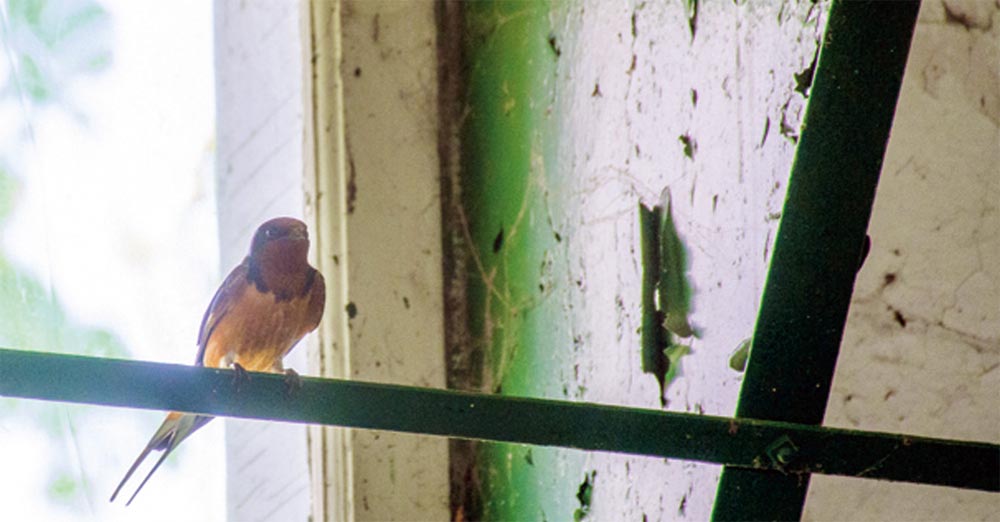
Over several decades, the barn swallow population has plummeted as more of their habitats are lost to new developments.
By Joel Wittnebel/The Oshawa Express
Old, abandoned barns may no longer be home to cows, horses or chickens, but one inhabitant still relies on the wooden nooks and crannies, and when they’re torn down, a threatened species takes another hit.
Barn Swallows, a threatened species since 2012, has seen a steady and concerning decline in populations since the 1970s, with populations dropping by approximately 66 per cent.
According to Kristyn Richardson, a stewardship biologist with Bird Studies Canada, the loss of habitat has been on of the suspected causes of this drop in populations.
“As old structures are replaced with modern designs or modified in a manner that no longer allows the birds access to nest, the supply of nest sites for barn swallows will continue to decline,” she says. “Additionally, barn swallows can show strong attachment to a particular nest site and the permanent loss of the structure may have detrimental effects on reproductive success.”
Barn swallows nest by attaching mud pellets to the sides of ledges or other man-made surfaces in barns, culverts or under bridges, usually close to open fields or waterways where they feed.
However, in recent years, the province has lent a helping hand, requiring the replacement habitats, or nesting structures, to be constructed whenever an original is lost, many of which can be seen in north Oshawa.
“Whenever an individual is modifying or demolishing a building or structure providing nest habitat for barn swallows, they must provide mitigation for this loss and these nesting structures have been used,” Richardson says.
Most recently, a series of these man-made habitats were erected along the newly paved expanse of Highway 407 as the expanded stretch of toll road eliminated more nesting spaces for these birds.
According to Darlene Proudfoot, a senior environmental planner with the Ministry of Transportation, the latest structures as part of the expansion to Simcoe Street North were built by Blackbird, the contractor responsible for the recent expansion. They will also be tasked with maintaining them.
Because it has only been three years since the regulations were implemented to protect these birds, Richardson says its tough to pinpoint whether there has been a significant positive impact.
“Monitoring populations is really a tricky thing because there are natural ups and downs in any population,” she says. “Only after many years of monitoring does it become more clear what the trajectory, increase or decline, of a population is.”
And while some homeowners have stepped in to erect their own structures out of concern for the birds, these structures can not replace what was lost.
“My experience has been that when a nice old barn, hosting dozens of nests, is demolished and replaced with a structure, we never usually see more than a few pairs nesting in the replacement habitat,” Richardson says. “So, no, they don’t replace what is lost, but without them, there would be no birds at all in a local area.”